Application of office lights
The essence of the application of office lights is to solve the core pain points of office scenes through scientific lighting, rather than simply meeting the need for "illumination". Its core value is reflected in three aspects:
Ensuring visual health and reducing work fatigue
In office settings, employees spend 6-8 hours a day facing screens or paper documents, and poor lighting (such as dim, bright, flickering, glare) can easily cause problems such as dry eyes, eye strain, and decreased vision. High quality office lights reduce the continuous tension of visual nerves and reduce work fatigue by controlling color temperature (3000K-5000K, suitable for different office hours), color rendering index (Ra ≥ 80, restoring the true color of files/screens), and illumination uniformity (desktop illumination ≥ 300lux, with no obvious brightness difference).
Improve work efficiency and adapt to task requirements
There are significant differences in the lighting requirements for different office tasks:
Creative work (design, planning) requires high color rendering and adjustable lighting to help accurately determine colors and details;
Focused work (programming, word processing) requires stable and soft lighting to avoid disturbing attention;
Meeting/collaboration scenarios require even and unobstructed lighting to ensure clear visibility during multi person interactions.
Office lights indirectly improve task completion efficiency through "functional adaptation" (research shows that ergonomic office lighting can increase work efficiency by 15% -20%).
Optimize the spatial atmosphere and convey the corporate image
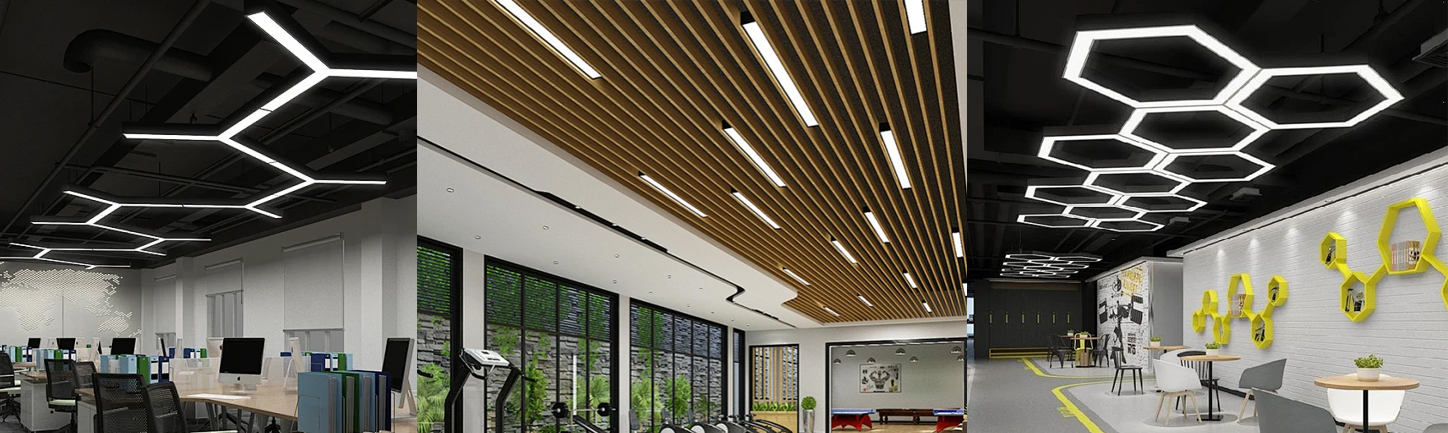
The design style of office lights (such as minimalist lines, suspended feeling, intelligent linkage effect) and lighting hierarchy (basic lighting+local lighting+ambient lighting) jointly shape the overall temperament of the office space:
The commonly used design of unmanned lights and intelligent dimming office lights in technology enterprises highlights simplicity and a sense of technology;
Traditional industries or law firms commonly use regular grid lights and warm white light to convey professionalism and stability;
Startup companies or co working spaces prefer modular and spliceable office lights to create a flexible and dynamic atmosphere.